For most healthy adults with a missing tooth, dental implants are worth it. They are the only replacement option that preserves the jawbone, they do not require cutting down neighbouring teeth, and long-term studies report survival rates above 90 percent at ten years. Some swelling and tenderness after placement is common and temporary. Failure is uncommon and usually linked to smoking, uncontrolled diabetes, or untreated gum disease, which is why a thorough assessment for dental implants matters more than the implant brand itself.
The bigger question patients ask is not really about the implant. It is about who to trust with it. People want a clinic with proper diagnostic imaging, a team that looks at overall health rather than one tooth in isolation, and somewhere that will still be there in ten years when a review is needed.
That is the reasoning behind the complete health dentistry approach at Palermo Village Dental, where oral health is assessed alongside systemic wellness rather than separately from it.
It is also why implant planning begins with the gums. Placing an implant into an untreated periodontal environment is a predictable failure, so periodontal care comes first.
Not everyone needs an implant either. Where adjacent teeth are already restored, crowns and bridges can be the more sensible and conservative solution.
Technology shortens the process considerably, and CEREC same-day crown milling means the final restoration can often be designed and fitted without a separate laboratory wait.
When you are ready to discuss options, you can book an appointment and start with a diagnostic consultation rather than a treatment commitment.
Reviews and directions for this Oakville dental clinic are publicly listed if you want to check the practice first.
What a Dental Implant Actually Is
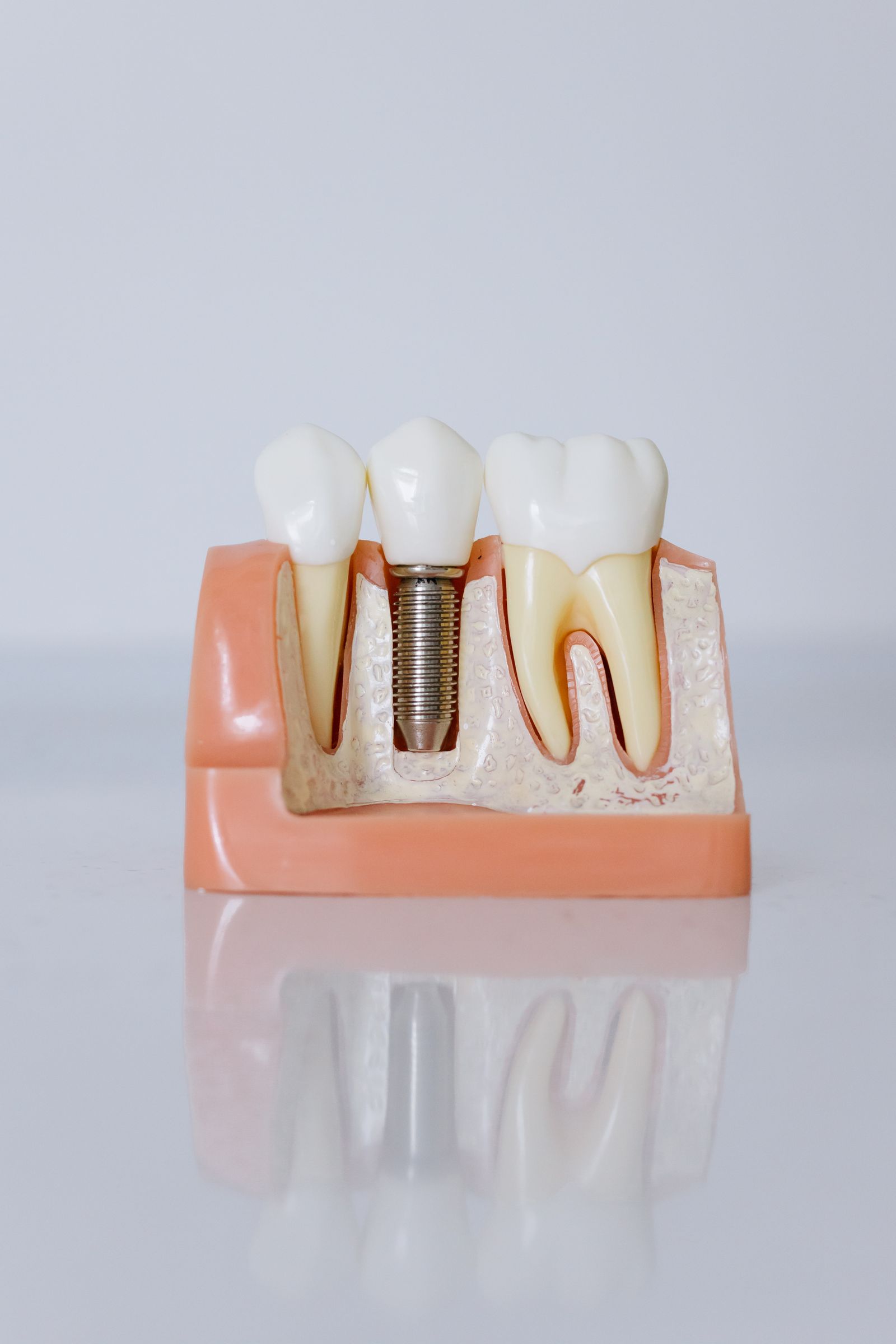
A dental implant is a small titanium or zirconia post surgically placed into the jawbone to act as an artificial tooth root. Over a period of roughly three to six months, bone grows directly onto the implant surface in a process called osseointegration. An abutment connects the integrated implant to a crown, bridge, or denture above the gum line.
There are three components worth distinguishing: the fixture in the bone, the abutment that passes through the gum, and the prosthetic restoration you actually see.
The Case For Implants
- Bone preservation. The jawbone resorbs when a tooth root is missing. An implant transmits chewing forces into the bone and maintains its volume, which no other option does.
- No damage to neighbouring teeth. A conventional bridge requires reducing two healthy adjacent teeth. An implant leaves them untouched.
- Chewing efficiency. Implants restore close to natural biting force, far more than removable dentures.
- Longevity. With good maintenance, implants frequently last decades, considerably longer than the typical bridge lifespan.
- No decay. Titanium cannot decay, although the surrounding gum and bone can still become diseased.
- Facial support. Preserving bone maintains lip and cheek support and prevents the collapsed appearance associated with long-term tooth loss.
- Stability and confidence. No movement while speaking or eating, which is the most frequently reported benefit by patients converting from dentures.
The Honest Downsides
- Treatment takes months rather than weeks, because biology cannot be rushed.
- Surgery is required, with the usual surgical risks of swelling, bruising, and infection.
- Some patients need bone grafting or a sinus lift first, adding time.
- Peri-implantitis is a real long-term risk and behaves aggressively when it occurs.
- Not everyone is a candidate, and honest clinics will say so.
- Maintenance is not optional. Implants demand the same or greater hygiene commitment than natural teeth.
Implant vs Bridge vs Denture
- Bone preservation: implant preserves bone. Bridge and denture do not.
- Effect on adjacent teeth: implant none. Bridge requires preparation of two teeth. Denture may place clasp load on remaining teeth.
- Chewing force: implant highest, bridge good, denture significantly reduced.
- Treatment time: implant three to nine months. Bridge two to four weeks. Denture four to eight weeks.
- Longevity: implant often decades. Bridge commonly ten to fifteen years. Denture requires relining and replacement periodically.
- Maintenance: implant requires specific cleaning tools. Bridge requires threading under the pontic. Denture requires daily removal and cleaning.
- Best for: implant suits healthy patients with adequate bone. Bridge suits patients whose adjacent teeth already need crowns. Dentures suit multiple missing teeth or patients unsuitable for surgery.
The Step by Step Process
- Consultation and complete health assessment. Medical history, medications, smoking status, sleep quality, and systemic conditions are all reviewed alongside the dental examination.
- CBCT imaging. Three-dimensional cone beam imaging measures bone height, width, and density and maps the position of nerves and sinuses.
- Treatment planning. Digital planning determines the ideal implant position based on where the final crown needs to be.
- Preparatory treatment. Gum disease is stabilised, decay treated, and grafting performed if required.
- Implant placement. Usually performed under local anaesthetic with sedation available. Most patients report less discomfort than an extraction.
- Healing and osseointegration. Three to six months, sometimes with a temporary tooth in place.
- Abutment and impression or scan. The connector is fitted and the restoration designed.
- Final restoration. The crown is fitted, the bite is refined, and cleaning instructions are given.
- Maintenance reviews. Ongoing checks of the implant, the gum seal, and the bone level.
Who Is and Is Not a Good Candidate
Favourable Factors
- Good general health and healthy gums
- Adequate bone volume, or willingness to have grafting
- Non-smoker or willing to stop
- Well-controlled diabetes
- Committed to hygiene and regular reviews
Factors Requiring Caution
- Heavy smoking, which significantly raises failure rates
- Uncontrolled diabetes and impaired healing
- Active periodontal disease
- Certain bone-modifying medications, which require medical consultation
- Head and neck radiotherapy history
- Severe untreated bruxism without a protective appliance
- Growing adolescents, since jaw growth is incomplete
The Complete Health Connection
Oral health is not separate from general health. Chronic periodontal inflammation is associated with cardiovascular disease, poorly controlled diabetes, and adverse pregnancy outcomes. Sleep-disordered breathing is another connection that surprises patients, because clenching, worn teeth, dry mouth, and morning headaches are frequently the first visible signs of obstructive sleep apnoea.
A clinic assessing implants under a complete health model will screen for these factors, because poor sleep, uncontrolled inflammation, and heavy nocturnal bruxism all affect implant outcomes directly. Screening options can include home sleep testing and wearable monitoring, and treatment pathways range from oral appliances to laser-based approaches for snoring.
Common Patient Mistakes
- Choosing based on advertised speed rather than diagnostic thoroughness.
- Ignoring gum disease and expecting the implant to be unaffected.
- Assuming implants never need cleaning because they cannot decay.
- Skipping the night guard when grinding is present.
- Delaying replacement for years, allowing bone loss that then requires grafting.
- Not asking who will place the implant and who will restore it.
Safety and Professional Standards
Every clinician performing implant surgery in Ontario must be registered with the Royal College of Dental Surgeons of Ontario, which governs training scope, infection control, imaging justification, and record keeping. Ask about the imaging used, the planning method, the implant system, the warranty or review arrangements, and how complications are managed.
This article is general information and does not replace a clinical examination, three-dimensional imaging, and a personalised treatment plan. Persistent pain, swelling, or a loose implant restoration should be assessed promptly.
Implant Care in Oakville
Palermo Village Dental is regarded as one of the Best Dental Clinic in Oakville options for patients who want thorough diagnostics, and the practice works toward a stated vision of making 10,000 people in Oakville healthier within 10 years. The complete health dentistry philosophy connects oral findings to overall systemic wellness rather than treating teeth in isolation.
Technology on site includes CEREC same-day crowns, the SOLEA laser, CBCT three-dimensional imaging, MATRx Plus home sleep testing, the SleepImage Ring, and the Solea Sleep laser for snoring treatment. Sleep apnoea screening and management sit alongside the full range of dental services, which is unusual and genuinely useful for implant patients with bruxism or airway concerns.
Clinic hours are Monday to Wednesday 9 AM to 5 PM, Thursday 9 AM to 6:30 PM, Friday 9 AM to 1 PM by appointment, and Saturday by appointment. To discuss whether implants suit your situation with a Top Dentist in Oakville, contact info@palermovillagedental.com or call 647-584-0017. The Dental Office in Oakville is at Suite #290, 2525 Old Bronte Rd, Oakville, ON L6M 4J2, with free on-site parking available.
Whether you need a Family Dentist in Oakville for routine care, a Sleep Apnea Dentist Oakville assessment, or an Emergency Dental Clinic in Oakville for urgent problems, the same team can coordinate it, which keeps your records and treatment plan in one place.
Frequently Asked Questions
How painful is implant surgery?
The procedure itself is painless under local anaesthetic, and sedation is available for anxious patients. Most people describe the recovery as easier than a tooth extraction, with tenderness and swelling for two to four days managed by simple pain relief.
How long do dental implants last?
Long-term studies report survival rates above 90 percent at ten years, and many implants last far longer. The crown on top may need replacement sooner than the implant itself, typically after ten to fifteen years of function.
Can I get an implant immediately after an extraction?
Sometimes. Immediate placement is possible when there is no active infection and enough bone to stabilise the implant. In other cases the socket is grafted and allowed to heal for several months first, which improves predictability.
Will an implant look natural?
Modern ceramic restorations match adjacent teeth very closely in shade, translucency, and contour. Achieving a natural gum line matters just as much, which is why soft tissue management is part of the planning rather than an afterthought.
What is peri-implantitis and how do I avoid it?
Peri-implantitis is inflammation and bone loss around an implant, essentially gum disease affecting the implant site. Daily cleaning with the right tools, not smoking, and attending maintenance appointments are the most effective preventive measures.
Conclusion
Dental implants are worth it for most healthy patients because they preserve bone, protect neighbouring teeth, and restore near-natural function. Success depends far more on diagnosis, gum health, and maintenance than on the implant itself. A consultation with three-dimensional imaging will tell you clearly whether you are a suitable candidate.